In the altarpieces of the Middle Ages and the Renaissance one detail returns insistently: the blue mantle of the Virgin. That deep, intense blue is neither a random nor a merely devotional choice. It was obtained with the most precious pigment a painter could use, ultramarine, and its use tells a fascinating story interweaving trade, theology and symbol.
A colour from far away
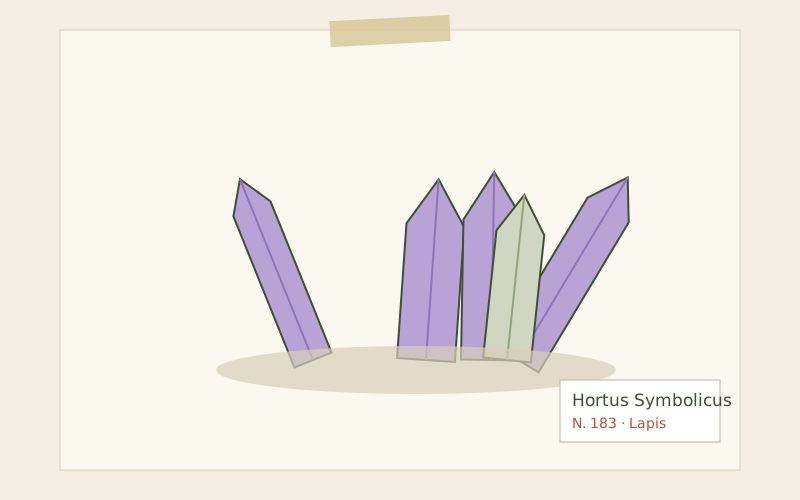
The name itself reveals the origin: ultramarine, coming from beyond the sea. The pigment was made from lapis lazuli, a blue rock mined for centuries in the mountains of Badakhshan, in present-day Afghanistan. From there the stone travelled along caravan routes to the ports of the eastern Mediterranean and then to Venice, which became one of the main centres of its trade in Europe.
Grinding lapis lazuli was not enough: the powder obtained was greyish. A long and delicate procedure was required, with pastes of waxes, resins and oils and repeated washings, to separate the blue particles from the impurities. The first extractions gave the purest and most expensive blue; the following ones, progressively paler shades.
More precious than gold
In the Middle Ages and the early Renaissance ultramarine could cost as much as gold, or even more. For this reason contracts for sacred works often specified exactly which blue was to be used and for which parts of the painting. The patron wanted the guarantee that the Madonna's mantle would be painted with genuine ultramarine and not with azurite, a cheaper blue pigment tending towards green.
The painter and theorist Cennino Cennini, in his Book of Art, devotes pages full of admiration to ultramarine, considering it the noblest of colours and describing its preparation with care. His testimony shows how much this pigment was perceived as something special, almost sacred.
Why the Virgin
The association of blue with Mary is not very ancient. In early Christian art and in part of Byzantine art the Virgin often wears dark colours, such as purple or a deep blue close to black, linked to mourning and dignity. It was above all between the twelfth and thirteenth centuries that blue established itself as her distinctive colour, thanks in part to stained glass and illuminated manuscripts.
The symbolic reasons overlap:
- The sky: Mary is venerated as Queen of Heaven, and blue is the colour of the celestial vault.
- The sea: the title Stella Maris, star of the sea, links her to water and to the guidance of sailors.
- Depth: blue is the colour that seems to recede, inviting contemplation and inner silence.
- Value: painting the Mother of God with the most expensive pigment was a form of offering.
The revaluation of blue
Historians of colour have observed that in classical antiquity blue did not enjoy great prestige in the West. The fact that Homer speaks of the «wine-dark» sea is often quoted to show how different ancient colour categories were from ours. The Marian success of blue in the Middle Ages contributed to a real revaluation: the colour went from marginal to noble, eventually becoming, in later centuries, one of the favourites of European culture.
Blue and interiority
In symbolic reading blue is a colour of limit and openness. It is the colour of distance: far-off mountains look bluish, and the sky is blue precisely because it is deep. This is why many traditions associate it with the spiritual dimension, with what is close to the soul but out of reach of the senses.
The Virgin's blue mantle, enveloping and protective, unites these ideas: it is the sky turned into a garment, the infinite that welcomes. In the meditative tradition cultivated by Studio Esoterico Cornelio, contemplating a work painted in ultramarine can become an exercise in recollection: letting the gaze rest on the colour, without hurry, as one looks at the sky at dusk.
A pigment becomes an industry
In the nineteenth century a synthetic ultramarine began to be produced, far cheaper. Blue thus lost its value as a rarity, but not its symbolic charge, which lives on in the works of the past and in religious imagination.
In short
- Ultramarine was made from lapis lazuli from the mountains of present-day Afghanistan.
- It was an extremely costly pigment, often compared to gold and regulated in contracts.
- Blue became the Virgin's distinctive colour mainly between the twelfth and thirteenth centuries.
- It symbolises sky, sea, depth and precious offering.
- The history of ultramarine shows how a colour can pass from marginal to sacred.