Rosemary is a household herb, found in gardens and on windowsills all around the Mediterranean. Its very familiarity risks hiding its symbolic richness. For centuries this plant with needle-like leaves and a resinous scent was the sign of remembrance, and for this reason it accompanied the two moments in which a community remembers most intensely: weddings and mourning.
A name that comes from the sea
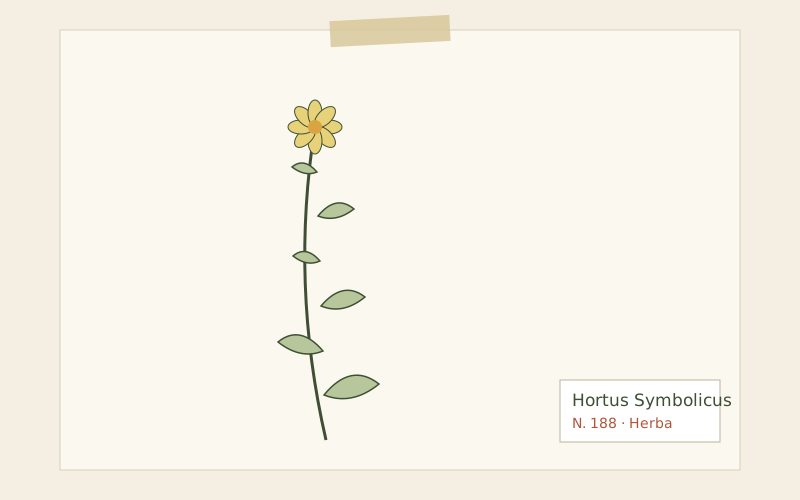
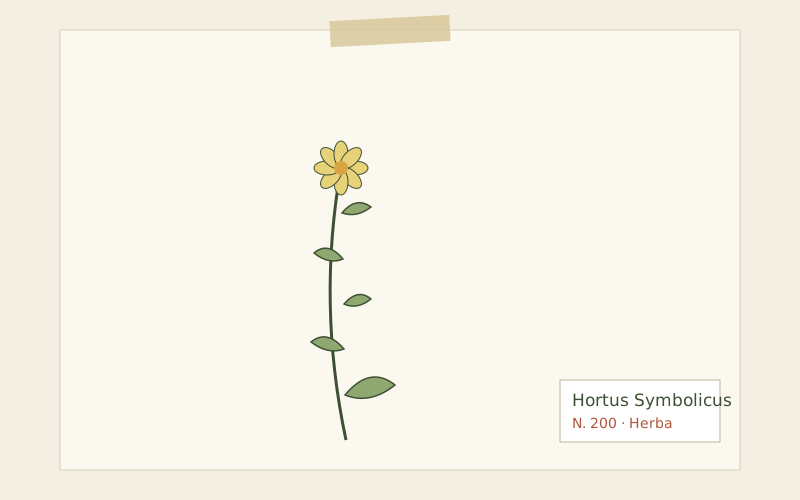
The Latin name ros marinus is commonly understood as "dew of the sea". The image fits: rosemary grows wild on coasts and on hills near the sea, and its small blue flowers truly look like drops of sky and water resting on the branches. From its very name, then, the plant unites opposite elements: the dry ground it lives on and the moisture of the sea that feeds it with its breezes.
The legend of the cloak
A Christian legend widespread in many European regions tells that, during the flight into Egypt, the Virgin Mary spread her blue cloak to dry on a rosemary bush. From that moment the plant's flowers, which had supposedly been white, took on the colour of the cloak.
The legend has a precise symbolic value: rosemary becomes a plant that has "received" something sacred and keeps it. The colour of the flowers is the memory of a contact. Once again, the plant is tied to remembrance.
"That's for remembrance"
The best-known literary reference is in Shakespeare's Hamlet. Ophelia, now distracted, hands out flowers and herbs to those present and, offering rosemary, says it is "for remembrance". The line shows that the Elizabethan audience knew the plant's meaning perfectly well: there was no need to explain it.
In Romeo and Juliet, too, rosemary appears at the moment when the planned wedding turns into a funeral. Friar Laurence bids them lay rosemary on the body of Juliet, believed dead. The same herb that was meant to adorn the marriage now accompanies mourning.
Weddings and funerals
In sixteenth- and seventeenth-century England, and in many other parts of Europe, rosemary had a precise role in both ceremonies:
- at weddings, sprigs of rosemary, sometimes gilded or tied with ribbons, were offered to guests and placed in the bride's bouquet;
- at funerals, mourners carried sprigs which they then threw into the grave, as a sign of a remembrance that should not be broken.
Why the same plant
It may seem odd that the same herb served both to celebrate and to grieve. In fact the meaning is consistent. A wedding is a moment of promise: one commits to remembering a pact for a lifetime. A funeral is a moment of faithfulness: one commits to not forgetting the one who departs. In both cases rosemary represents memory as a bond, the ability to stay connected over time.
The fact that it is evergreen strengthens the symbol: its leaves do not fall, just as remembrance should not.
Rosemary in the symbolic garden
In the traditional language of plants, rosemary belongs among the herbs of faithfulness. Beside it, in popular usage, one often finds myrtle for love and laurel for glory. Together they form a small plant alphabet that communities used to express what words alone could not say.
Maestro Cornelio invites us to see rosemary as a plant of the domestic threshold: it grows near the house and scents the kitchen, yet it also accompanies life's most solemn passages. It is the symbol of a memory both everyday and sacred, one that needs no temple in order to exist.
A small exercise in attention
Those who grow rosemary can make it a support for recollection. Touching a sprig, smelling its resinous scent and calling to mind a loved one or a promise made is a gesture ancient in form: the plant becomes a living reminder, a place where memory settles.
| Moment | Traditional use | Meaning |
|---|---|---|
| Wedding | Sprigs for guests and in the bouquet | Promise, a pact to remember |
| Funeral | Sprigs thrown into the grave | Faithfulness to the departed |
| Daily life | Plant near the house | Family memory and continuity |
In short
- The name ros marinus recalls the "dew of the sea" and the coasts where it grows.
- A legend links the blue of its flowers to the Virgin's cloak.
- In Shakespeare, Ophelia offers rosemary "for remembrance".
- In early modern Europe it accompanied both weddings and funerals.
- Its symbol unites memory, promise and faithfulness.