Johann Wolfgang von Goethe is remembered above all as a poet and the author of Faust. Yet he considered one of his most important works a long scientific and philosophical treatise: the Theory of Colours, Zur Farbenlehre, published in 1810. In these pages Goethe proposes a vision of colour radically different from that of Newtonian physics, and for precisely this reason it still fascinates artists, philosophers and students of symbolism.
Colour as the meeting of light and darkness
For Newton white light contains all colours within itself, and a prism merely separates them. Goethe rejected this idea. For him colour arises from the meeting of light and darkness, when the two interact through a more or less turbid medium.
Goethe gives examples drawn from everyday observation:
- The sun, seen through an atmosphere laden with vapour, appears yellow, then orange and red at sunset: light passes through a turbid medium and «darkens» towards the warm.
- The sky, seen against dark space, appears blue: darkness seen through an illuminated medium «lightens» towards the cool.
- Smoke in front of a dark background looks bluish; in front of a light background it tends towards yellow.
From these observations he derives two fundamental colours: yellow, closest to light, and blue, closest to darkness.
Polarity
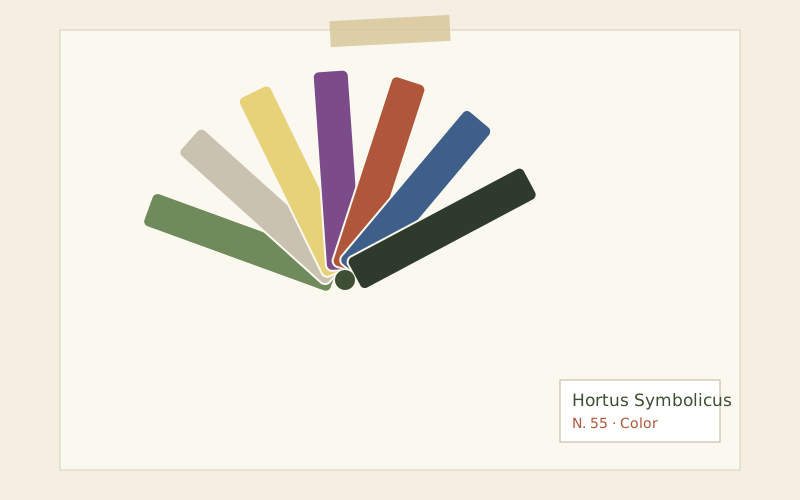
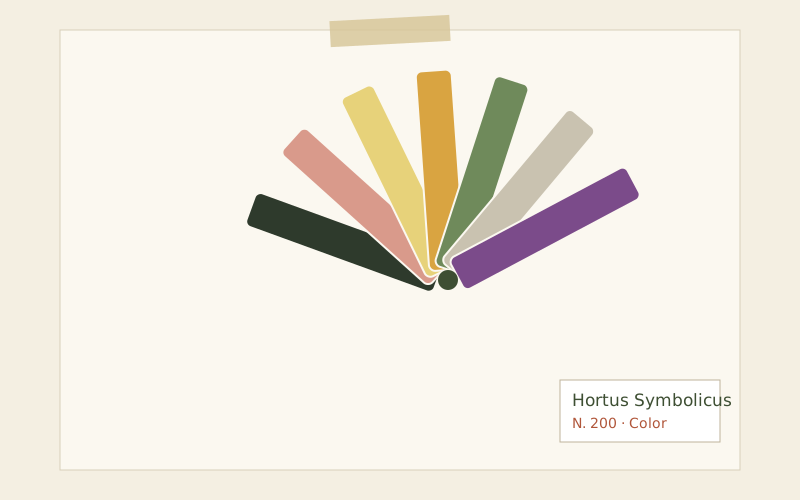
Goethe's thought is deeply polar. Yellow and blue are opposites like light and shadow, warm and cold, active and passive. As they intensify, each tends towards red: yellow towards orange, blue towards violet. Their common culmination is purple, which Goethe considered the highest colour, the synthesis of the two polarities. Their simple mixture, on the other hand, gives green, a colour of balance and rest.
A harmonious structure thus emerges:
| Light pole | Dark pole |
|---|---|
| yellow | blue |
| orange | violet |
| common summit: purple | mixture: green |
The colour circle
Goethe arranged the colours in a circle, in which each colour stands opposite its complementary. He noticed that the eye, after staring for a long time at a colour, tends to see the opposite colour on a white surface: after red a greenish image appears, after yellow a violet one. For him this proved that the eye actively seeks totality and harmony.
His observations on afterimages, coloured shadows and simultaneous contrast are still considered valuable by scholars of perception today.
The sensory and moral effect of colours
Part of the work is devoted to what Goethe calls the sensory and moral effect of colours, that is, their effect on the soul. He divides colours into two groups:
- Plus side: yellow, orange, red-yellow, which give a sense of liveliness, striving and warmth.
- Minus side: blue, blue-red, red-blue, which arouse restlessness, recollection or longing.
Blue, Goethe says in substance, draws us as something that recedes, like the sky and distant mountains. Yellow has a serene and cheerful nature, but very little is needed to soil it and make it unpleasant. These are pages in which physics opens onto psychology and aesthetics.
The dispute with Newton
Goethe attacked Newton's theory vehemently, accusing it of imprisoning light in an artificial experiment. The scientists of his time and of the following centuries did not accept his physics, which rested on assumptions different from quantitative measurement. Today it is generally recognised that the two authors were answering different questions: Newton studied the physical nature of light, Goethe the lived experience of colour.
The legacy
The Theory of Colours influenced painters such as William Turner, who explicitly dedicated some works to it, and numerous thinkers. In the twentieth century anthroposophy and various artistic schools took up its ideas. For those who study symbolism, Goethe offers a valuable model: colour not as a mere physical datum, but as a phenomenon involving both the world and the soul.
A symbolic reading
Goethe's idea has a deep traditional resonance: there is no colour without shadow. Pure light blinds, pure darkness hides; only their meeting makes the world visible and coloured. It is a principle found in many spiritual paths: inner life does not consist in fleeing the shadow, but in letting light pass through it.
In short
- Goethe published the Theory of Colours in 1810, opposing Newton's physics.
- For him colour arises from the meeting of light and darkness through a turbid medium.
- Yellow and blue are the fundamental poles; purple is their culmination, green their mixture.
- Goethe studied afterimages, contrasts and the «moral» effect of colours on the soul.
- His work remains an important source for art, perception and symbolism.