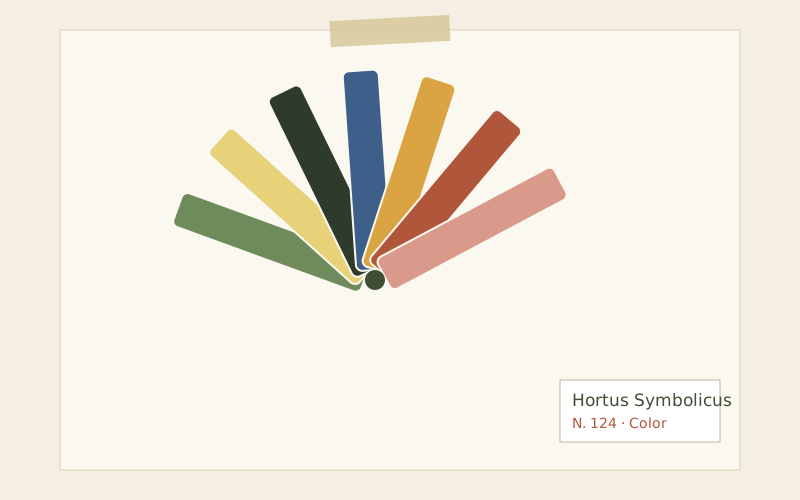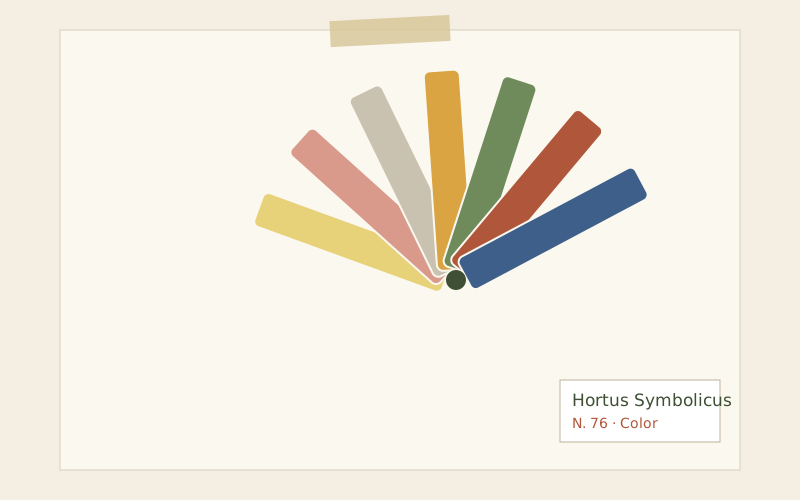
In Vajrayana Buddhism, widespread above all in Tibet, Nepal, Bhutan and Mongolia, colours play a central role in sacred art and meditation. One of the most important systems is that of the five Buddhas, often called wisdom Buddhas or Tathagatas, arranged at the centre and at the four cardinal points of a mandala. Each has a colour, a direction, a gesture and a quality of its own.
The mandala as cosmos
The mandala is a symbolic representation of an ordered universe, with a centre and four directions. In Tibetan meditative practice it is not only an image to look at, but a space to visualise inwardly, inhabited by figures embodying qualities of the awakened mind.
The five Buddhas form one of the fundamental structures of many mandalas. Their most common arrangement is the following:
| Buddha | Direction | Colour |
|---|---|---|
| Vairocana | centre | white |
| Akshobhya | east | blue |
| Ratnasambhava | south | yellow |
| Amitabha | west | red |
| Amoghasiddhi | north | green |
In some traditions the positions of Vairocana and Akshobhya may be exchanged, with blue at the centre and white in the east. These are internal variants that show the flexibility of the system.
The five colours and the five wisdoms
To each Buddha tradition associates a wisdom, that is a quality of the enlightened mind, and a corresponding poison, a mental state that clouds the ordinary mind. Practice does not aim to suppress the poison, but to recognise its deeper nature, which is the same as that of the corresponding wisdom.
- White, Vairocana: the wisdom of all-pervading space; corresponds to ignorance or dullness.
- Blue, Akshobhya: the mirror-like wisdom, which reflects everything without distortion; corresponds to anger.
- Yellow, Ratnasambhava: the wisdom of equanimity, which recognises the equal worth of all beings; corresponds to pride.
- Red, Amitabha: discriminating wisdom, which sees each thing in its particularity; corresponds to desire and attachment.
- Green, Amoghasiddhi: the all-accomplishing wisdom; corresponds to envy.
The precise associations may vary between lineages and texts, but the underlying idea remains: each colour is both a problem of the mind and its transformation.
Amitabha and the Pure Land
Of the five, Amitabha, the Buddha of «infinite light», has had particular fortune outside the Vajrayana as well. His colour is red, his direction the west, where the sun sets. In East Asian Buddhism he is at the centre of the Pure Land schools, which cultivate devotion to him and the aspiration to be reborn in his western paradise.
Amitabha's red is not the red of destructive passion, but that of compassionate love, of the sun that at sunset bathes everything in a warm light.
Prayer flags
The five colours also appear in one of the most visible objects of the Himalayan landscape: prayer flags. They are rectangles of cloth printed with prayers and images, hung in sequence on ropes stretched between trees, houses or mountain passes. The order of the colours is usually: blue, white, red, green, yellow.
These colours are often associated with the five elements: space or sky, air, fire, water, earth, although the exact correspondences vary. According to tradition, the wind that moves the flags spreads into the environment the prayers and good wishes printed on them, for the benefit of all beings.
The rainbow body
In the Tibetan tradition there also appears the idea of the «rainbow body», which indicates the supreme realisation of certain masters, whose physical form is said to dissolve into light. Without entering into an assessment of these accounts, which belong to the dimension of faith, one may note their symbolic coherence: the goal of the path is described as the return of all colours to the light from which they come.
A symbolic reading
The system of the five Buddhas offers a refined way of thinking about colours: not as fixed labels of «good» or «bad», but as energies that can manifest in a confused form or a clear one. Anger and mirror-like clarity are the same blue; desire and compassion the same red. For those who study symbolism it is a valuable lesson: every colour has a shadow and a light, and transformation consists in recognising both.
In short
- In Vajrayana the five Buddhas occupy the centre and the four directions of the mandala.
- Their colours are white, blue, yellow, red and green.
- Each colour corresponds to a poison of the mind and the wisdom that transforms it.
- Amitabha, red and western, is also central to the Pure Land schools.
- Prayer flags repeat the five colours linked to the elements.