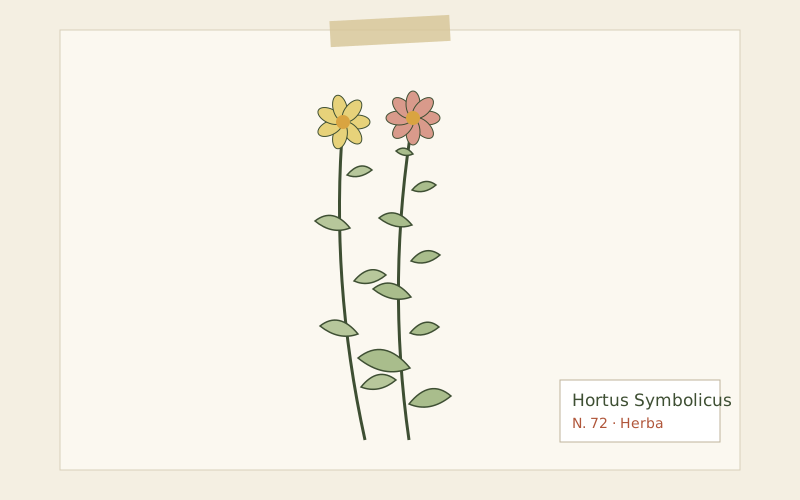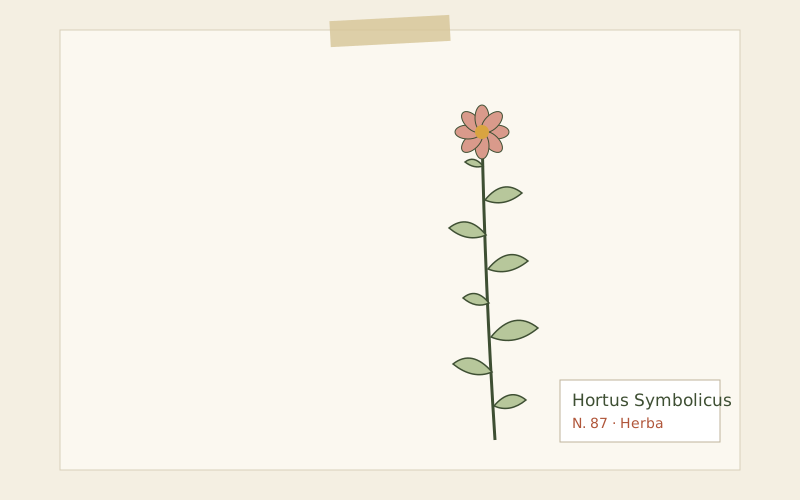
Hyssop is a small, humble plant that in the Bible often appears beside what is great and solemn. It is the herb that grows on walls, at the opposite extreme from the majestic cedar of Lebanon. Yet this very humility makes it central to some of the most important rites of the biblical tradition. Hyssop is, par excellence, the herb of purification: the instrument with which ritual water or blood is sprinkled to mark a passage from impure to pure.
Which plant?
Biblical hyssop, ezov in Hebrew, does not necessarily coincide with the plant we call hyssop in Europe today. Many scholars identify it with a species of wild oregano common in the Near East, with branching stems and hairy leaves well suited to holding liquid. As often happens with ancient plants, the identification remains debated, but the ritual function is clear.
From cedar to hyssop
The first book of Kings tells that King Solomon possessed vast wisdom and spoke of plants, "from the cedar of Lebanon to the hyssop that springs out of the wall". The pairing of cedar and hyssop expresses the whole of the plant world: from the tallest and most majestic to the smallest and most modest.
This polarity matters. In biblical symbolism hyssop represents humility, and humility itself becomes the instrument of purification.
The night of the first Passover
The oldest and most decisive episode is in the book of Exodus. On the night of liberation from Egypt, the Israelites are commanded to sacrifice a lamb for each household, to take a bunch of hyssop, dip it in the blood and mark the lintel and doorposts with it. That sign would protect the houses during the passing of the destroying angel.
Here hyssop is the instrument that draws the boundary between inside and outside, between who is protected and who is not. The door of the house, marked with the humble herb, becomes a sacred threshold.
The rites of purification
In the book of Leviticus hyssop appears in the rites by which a person, declared pure by the priest, was restored to the community. The rite called for cedar wood, a scarlet thread and hyssop, together with water and blood. The same trio recurs in the book of Numbers, in the rite of the red heifer, whose ashes were used to prepare the water of purification.
The combination is telling:
| Element | Symbolic meaning |
|---|---|
| Cedar | Height, endurance, nobility |
| Scarlet | Life, blood, intense colour |
| Hyssop | Humility, the instrument of the gesture |
The highest and the lowest of the plant world, joined by the colour of life, make up the instrument of purification.
"Purge me with hyssop"
The best-known text is Psalm 51, the Miserere, traditionally attributed to David after his sin. The psalmist asks: "Purge me with hyssop, and I shall be clean; wash me, and I shall be whiter than snow". Here hyssop passes from outward rite to the inner dimension: purification no longer concerns only the body or the house, but the heart.
The Asperges of the liturgy
This verse entered Christian liturgy. In the Roman rite, at the beginning of Sunday Mass, the priest may sprinkle the faithful with holy water while the antiphon Asperges me is sung, which takes up Psalm 51. The instrument used for sprinkling, the aspergillum, is the liturgical descendant of the bunch of hyssop.
The hyssop of Calvary
Hyssop also appears in John's account of the Passion. When Jesus on the cross says he thirsts, those present fix a sponge soaked in vinegar to a stalk of hyssop and raise it to his mouth. For many commentators the detail deliberately recalls the first Passover: the hyssop that marked the doors with the lamb's blood appears beside the one the Gospel presents as the Lamb.
Symbolic reading
Studio Esoterico Cornelio reads hyssop as the symbol of a simple and profound spiritual truth: purification passes through humility. It is not the great cedar that performs the gesture, but the little herb of the wall. Whoever wishes to be renewed must first accept becoming small.
In short
- Biblical hyssop is probably a species of wild oregano from the Near East.
- Solomon spoke of plants "from the cedar to the hyssop", from the greatest to the humblest.
- At the first Passover a bunch of hyssop marked the doors with the lamb's blood.
- Psalm 51 asks to be sprinkled with hyssop, the origin of the Asperges me.
- Its symbol teaches that purification passes through humility.