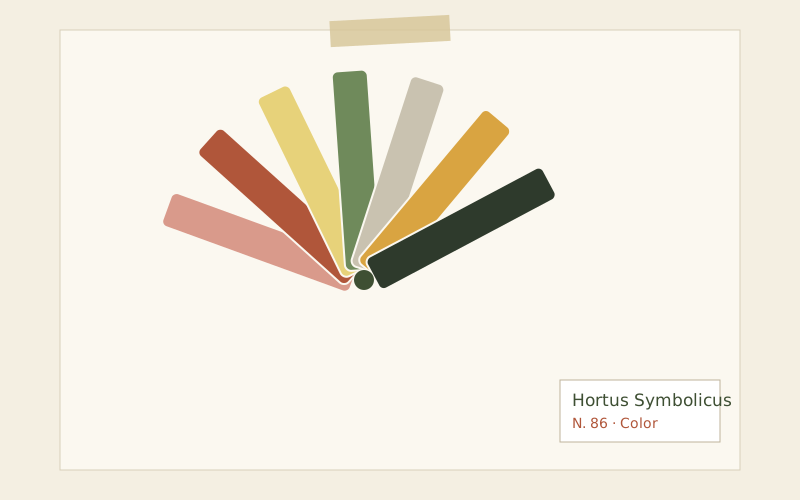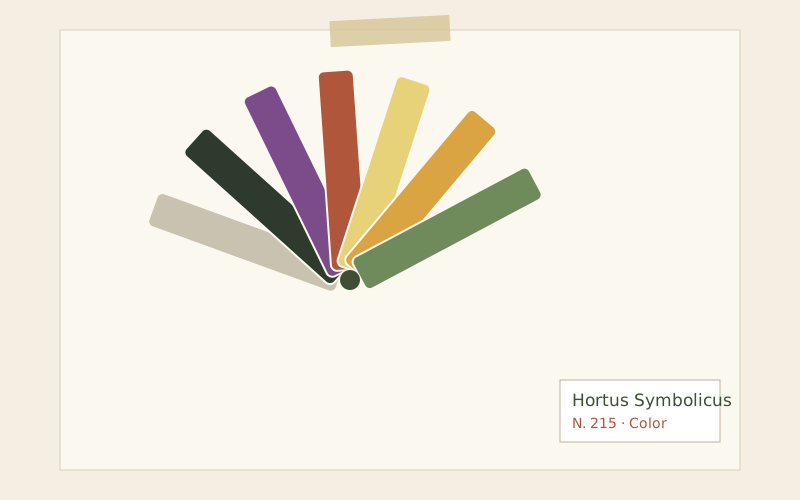
When we say something is «red» or «blue» we seem to be describing a natural fact, the same for everyone. But it is enough to compare different languages and cultures to realise that the way of naming colours varies profoundly. The spectrum of light is continuous; it is words that draw boundaries within it. Understanding this is essential for anyone studying colour symbolism: before asking what a colour means in a tradition, we must ask how that tradition named it.
The wine-dark sea
One of the most discussed cases concerns Homeric poetry. In the Iliad and the Odyssey the sea is often described with an expression translated as «wine-dark» or «wine-coloured». In the nineteenth century the British scholar and statesman William Gladstone, in his studies of Homer, observed that the Homeric colour vocabulary seemed very different from ours, with few words for blue and surprising uses for other colours.
The explanations offered over time have been many. Today it is generally held that the archaic Greeks perceived colours as we do, but classified them differently, giving great importance to brightness, sheen and the movement of the surface rather than to hue alone. The «wine-dark» sea may evoke the dark, glittering depth of the water more than a precise shade.
Blue and green: a single word
Many of the world's languages use a single term for what in English we distinguish as blue and green. Scholars sometimes call this category by a blended term, grue, from green and blue.
In Japanese, for example, the word ao traditionally indicated both blue and certain shades of green. Even today the green traffic light is commonly called by this term, and the same goes for some vegetables and fresh grass. It is not «confusion», but a different way of organising the continuum of colours.
Basic colour terms
In 1969 the anthropologists Brent Berlin and Paul Kay published a study that became famous, Basic Color Terms. Analysing many languages, they proposed that there are certain basic colour terms and that languages tend to acquire them in a relatively regular order:
- First the distinction between light and dark, that is white and black.
- Then red.
- Then green or yellow.
- Then blue.
- Then brown.
- Finally other terms such as purple, pink, orange and grey.
The theory has been debated, corrected and refined in the following decades, and many scholars have criticised some of its aspects. But it posed a fundamental question: is there something universal in colour names, linked to human perception, or does everything depend on culture? The most widely shared answer today is that both dimensions matter.
Red, the first colour
The fact that, after light and dark, red is often the first colour to receive its own name has struck many students of symbolism. It is the colour of blood, of fire, of the ochre used in prehistoric burials. Perhaps its presence in languages reflects precisely its importance in human life: the colour that signals life, danger, celebration.
When a colour has no name
What does it mean, for a culture, not to have a specific name for a colour? It does not mean it does not see it. It means it does not consider it an autonomous category, worthy of being separated from the others. This has important consequences for the study of symbols:
- We cannot project our categories onto ancient texts without caution.
- A translation such as «blue» or «purple» may cover shades very different from those we imagine.
- Symbolic meanings are often tied to qualities such as gloss, opacity and intensity, as well as hue.
A symbolic reading
| Example | What it teaches |
|---|---|
| Homer's sea | ancient colours include light and movement |
| Japanese ao | the boundaries between colours vary |
| Berlin and Kay | there are common tendencies across languages |
| Primacy of red | the colour of life is named early |
For those who cultivate the study of tradition, this awareness is an exercise in humility. Every culture sees the world through its own words, and colours are no exception. Reading an ancient text means learning to look with different eyes, accepting that another people's «red» may not coincide with ours. In this distance there is room to discover new nuances, within ourselves as well.
In short
- The spectrum is continuous: it is languages that divide it into distinct colours.
- Homer's «wine-dark sea» shows a different way of classifying colours.
- Many languages use a single term for blue and green.
- In 1969 Berlin and Kay proposed a sequence of basic colour terms.
- Studying symbols requires attention to how each culture names colours.