In the popular imagination the Grail is a cup: the chalice of the Last Supper, or the vessel in which Christ's blood is said to have been gathered. But medieval tradition is not so uniform. In one of the greatest poems of the German Middle Ages, Wolfram von Eschenbach's Parzival, the Grail is not a vessel but a stone. This choice opened a very rich symbolic line, in which the mystery of the Grail intertwines with that of gems.
The different forms of the Grail
The first author to speak of the Grail is Chrétien de Troyes, in his unfinished romance Perceval, or the Story of the Grail, written at the end of the twelfth century. Here the graal is a precious dish, carried in procession in the castle of the Fisher King, and its nature remains mysterious. Later, in the romances of Robert de Boron and in the prose cycles, the Grail becomes the vessel of the Last Supper linked to Joseph of Arimathea.
Wolfram, writing in the first decades of the thirteenth century, reworks Chrétien's story but radically changes the sacred object.
The lapsit exillis
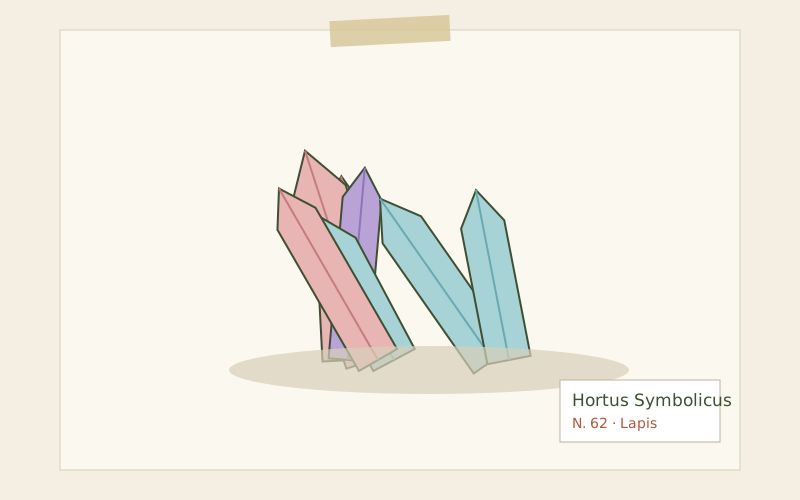
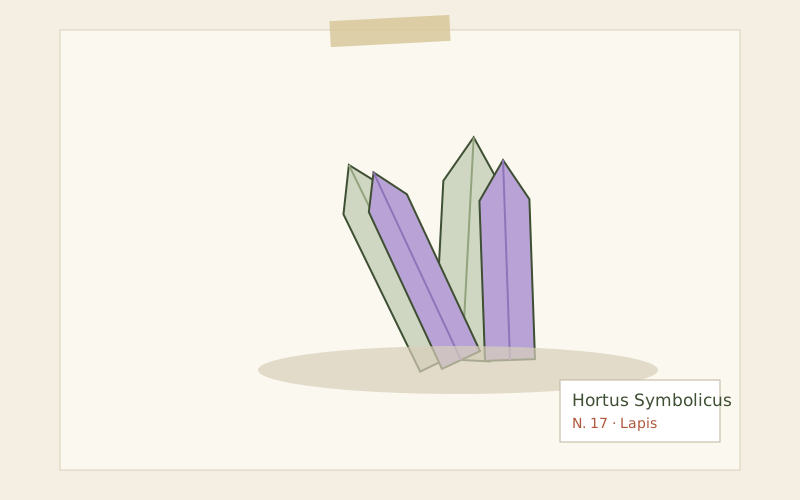
In Parzival the Grail is a stone kept in the castle of Munsalvaesche by a community of knights called Templeisen. Wolfram designates it with a mysterious Latin expression, lapsit exillis, which scholars interpret in different ways: perhaps a corrupt form of lapis ex caelis, "stone from heaven", or of lapis exilis, "humble, small stone". No reading is certain, and the ambiguity has fuelled centuries of interpretation.
The properties Wolfram attributes to the stone are extraordinary:
- every Good Friday a dove descends from heaven and lays a white wafer on the stone, from which the stone draws its power;
- the phoenix, burning, is reduced to ashes and is reborn through this stone;
- whoever beholds it does not die in the week that follows;
- inscriptions appear on the stone bearing the names of those called to the service of the Grail.
Wolfram also tells that the stone was brought to earth by the angels who remained neutral during Lucifer's rebellion. He further claims to have received the story from a certain Kyot of Provence, who supposedly found it in Toledo in a manuscript by a pagan sage called Flegetanis. Kyot's existence is much debated and many consider him a literary device.
Lucifer's emerald
Alongside Wolfram's poem, a tradition spread in the German-speaking world according to which the Grail was made from a gem that fell from Lucifer's crown at the moment of his fall from heaven. This gem is identified as an emerald. The tale appears in texts linked to the so-called Wartburg Song Contest, a group of medieval compositions in which Wolfram himself appears as a character.
The symbol is very powerful: what was lost in the fall becomes, transformed, the instrument of redemption. The rebel's stone becomes the stone of grace.
The Sacro Catino of Genoa
The legend of the emerald cup has a material counterpart. The treasury of the cathedral of San Lorenzo in Genoa holds the Sacro Catino, a green hexagonal dish that the Genoese brought home after the capture of Caesarea, in the Holy Land, at the beginning of the twelfth century. For centuries it was venerated as an object carved from a single enormous emerald, and identified by some with the vessel of the Last Supper.
At the beginning of the nineteenth century, in the Napoleonic era, the Catino was taken to Paris. On the return journey it broke, and examination of the fragments revealed that it was not emerald but glass. Reassembled, it is still in Genoa today. Its story illustrates well how the symbolic value of an object can precede and surpass its material nature.
Why a stone
That the Grail is a stone is no detail. A cup is a container: it holds something sacred that comes from outside. A stone, by contrast, is sacred in itself: it is a centre, a foundation, something that endures. In the biblical tradition Christ is called the cornerstone; in the alchemical tradition the goal of the Work is a stone. Wolfram's Grail-stone sits within this horizon: not an object to be filled, but a presence from which nourishment and rebirth flow.
| Form of the Grail | Source | Prevailing meaning |
|---|---|---|
| precious dish | Chrétien de Troyes | mystery to be understood |
| vessel of the Last Supper | Robert de Boron | memory of the sacrifice |
| stone | Wolfram von Eschenbach | unchanging centre, rebirth |
The inner quest
Symbolically, the quest for the Grail has always been read as an inner path. Parzival fails the first time because he does not ask the right question: he sees the Grail but does not ask. Only after long wandering, matured by experience, does he manage to return and pose the question of compassion that redeems the king and the kingdom. The stone stays the same: it is the seeker who must change.
In short
- In Wolfram von Eschenbach's Parzival the Grail is not a cup but a stone, called lapsit exillis.
- Every Good Friday the stone receives a wafer brought by a dove, and it makes the phoenix reborn.
- A German tradition links it to the emerald fallen from Lucifer's crown.
- The Sacro Catino of Genoa, venerated as an emerald, turned out to be glass, yet keeps its symbolic value.