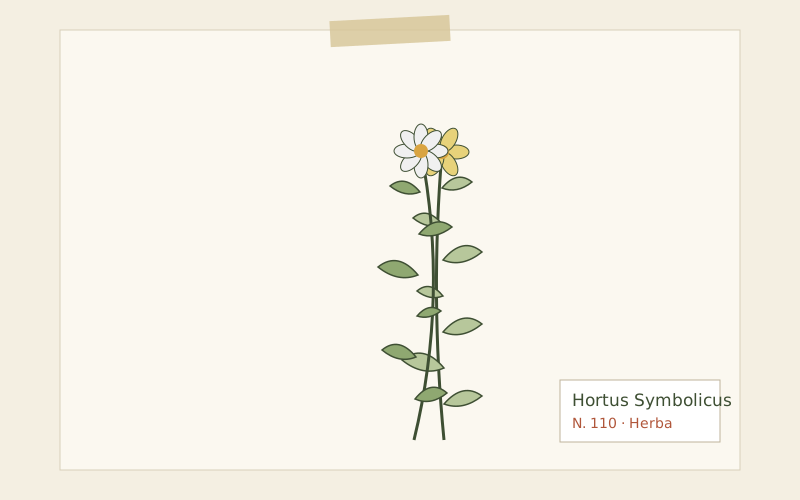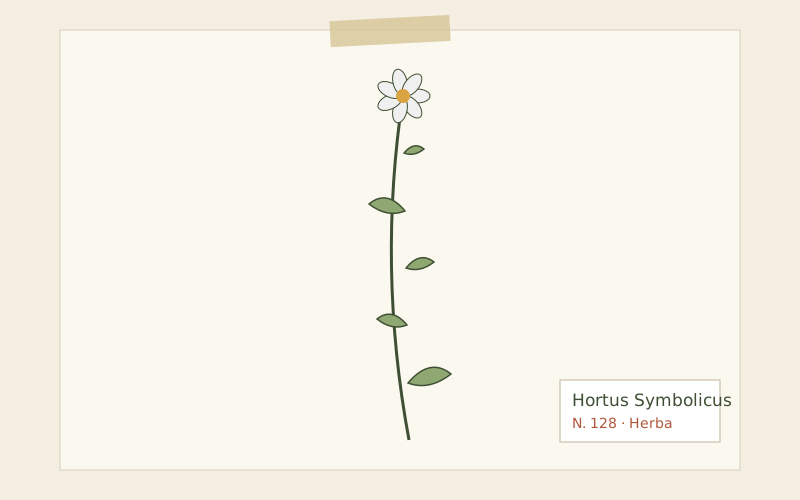
The narcissus blooms at the end of winter, when the earth is still cold, with white or yellow corollas that bend slightly downwards, as if gazing at the ground. This bearing, together with its early beauty, inspired two great tales of Greek mythology. In both, the flower is tied to a threshold: between self and other in the first, between life and the underworld in the second.
Echo and Narcissus
The most famous version of the myth is in the third book of Ovid's Metamorphoses. At Narcissus's birth, his mother asks the seer Tiresias whether her son will live long. The answer is enigmatic: he will live long "if he does not come to know himself".
Narcissus grows up beautiful and rejects all who love him. Among them is the nymph Echo, condemned by Juno to be able only to repeat the last words she hears. Rejected, Echo wastes away until she becomes pure voice. As punishment, Narcissus falls in love with his own image reflected in a clear spring. Unable to reach it or tear himself away, he pines until death. When the nymphs seek his body for the funeral rite, they find in its place a flower with a yellow heart surrounded by white petals.
Tiresias's prophecy
The seer's words overturn the famous Delphic precept "know thyself". For Narcissus self-knowledge is fatal, because it is not true knowledge: it is the fascination of an image mistaken for a person. The myth thus distinguishes two ways of looking at oneself: the contemplation that leads to awareness and the mirroring that imprisons.
A different version: Pausanias
The Greek traveller Pausanias, who visited the spring of Narcissus in Boeotia, reports a variant of the tale. Narcissus supposedly had a twin sister, identical to him, who died young. Gazing into the spring, he sought in the reflected image the face of his lost sister. Pausanias himself notes that the flower already existed before, since older accounts name it.
In this version the myth changes tone: no longer vanity, but mourning and longing. The reflection is the memory of someone who is gone.
Persephone's flower
The second great tale is in the Homeric Hymn to Demeter. Young Persephone is picking flowers in a meadow with her companions: roses, crocuses, violets, irises, hyacinths. Earth, by Zeus's will and to favour Hades, makes a marvellous narcissus grow, from which a hundred blooms spring, and whose scent gladdens the sky, the earth and the sea. Persephone reaches out to pick it; at that moment the earth opens and Hades carries her off in his chariot.
Here the narcissus is a divine lure, the beauty that leads towards the underworld. The act of picking it marks the passage from girlhood to the condition of queen of the dead.
Torpor and depth
Some ancient authors already linked the name of the narcissus to a Greek word meaning torpor, numbness. Beyond etymology, the association is telling: in both myths the flower leads to a state of stillness, Narcissus's fixity before the water, Persephone's descent into darkness.
Plotinus and the image in the water
The Neoplatonic philosopher Plotinus, in his treatise on beauty, uses an image that recalls the myth: whoever rushes to seize the beauty reflected in water, mistaking the image for reality, sinks and is lost. For Plotinus sensible beauties are reflections of a higher beauty, and the true way consists in turning towards their inner source.
From myth to modernity
The narcissus has kept speaking to European culture. William Wordsworth made it the subject of one of the best-known poems in the English language, in which a host of dancing daffodils returns to memory in moments of solitude. In the twentieth century Sigmund Freud used the name of Narcissus to define narcissism, turning the myth into a concept of modern psychology.
Studio Esoterico Cornelio reads the narcissus as an invitation to vigilance: beauty is a door, but it can lead to contemplation or to imprisonment.
| Tale | Role of the narcissus | Meaning |
|---|---|---|
| Ovid | Flower born from the youth | The mirror that imprisons |
| Pausanias | Memory of the sister | Mourning, longing |
| Hymn to Demeter | Hades's lure | Threshold to the underworld |
| Plotinus | Image in the water | Reflected beauty and true source |
In short
- In Ovid's myth Narcissus falls in love with his reflection and becomes a flower.
- Tiresias's prophecy overturns the precept "know thyself".
- Pausanias reports a version in which the reflection is the face of a lost sister.
- In the Hymn to Demeter the narcissus lures Persephone towards her abduction by Hades.
- Plotinus uses the image of water to distinguish reflected beauty from its source.