Some plants seem to have a personal relationship with the sun. Their leaves and flowers turn towards the light, follow it through the day, face east in the morning. The ancients named this phenomenon with a Greek word meaning "turning towards the sun": heliotropism. Around these plants grew one of the most moving myths of Ovid's Metamorphoses, and later a rich symbolism of the soul turned towards the light.
The myth of Clytie
Ovid tells the story in the fourth book of the Metamorphoses. Clytie, a nymph and daughter of Ocean, was loved by the Sun, who however abandoned her for another young woman, Leucothoe. Wounded by jealousy, Clytie revealed the affair to Leucothoe's father, who punished his daughter terribly, burying her alive beneath a mound of sand.
The Sun did not forgive Clytie and never returned to her. The nymph, consumed by love and remorse, sat on the bare ground in the open. For nine days she stayed there without food or water, living only on dew and tears, her gaze always turned to the god crossing the sky. Slowly her limbs took root in the soil and her face became a flower. Transformed into a plant, Clytie still turns towards the Sun she loves.
A love that becomes faithfulness
The myth is ambivalent. Clytie is not a blameless heroine: her jealousy causes the death of another young woman. Yet her final transformation expresses an absolute faithfulness, a love that asks nothing more and simply gazes. In this passage from destructive passion to silent contemplation lies the heart of the symbol.
The heliotrope of the ancients
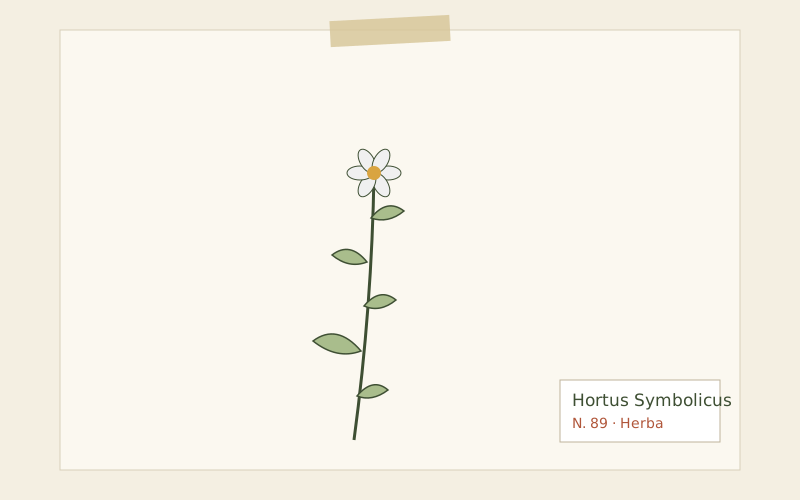
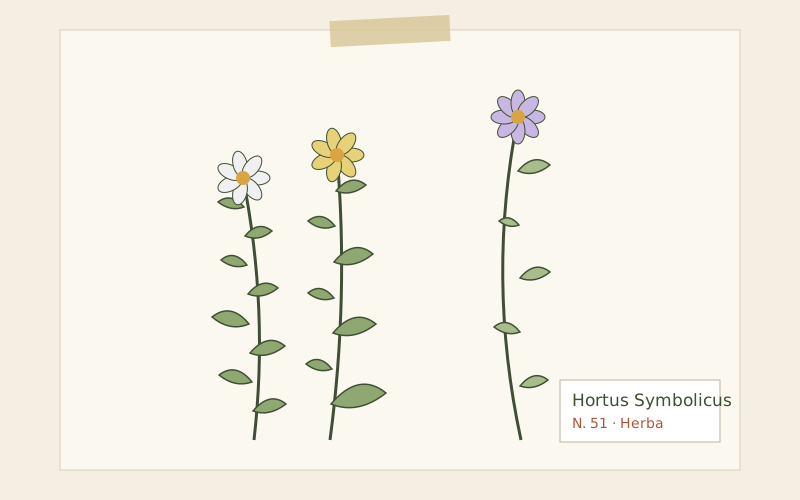
Ovid does not give Clytie's flower a precise botanical name. The description suggests a small violet-coloured flower, and tradition identified it with the heliotrope, a name the ancients used for plants that followed the sun. It is impossible to say for sure which species they meant: the term indicated a quality more than a specific plant.
It is important to note that the sunflower, now associated almost automatically with Clytie, was unknown in the ancient world.
The arrival of the sunflower
The sunflower is native to the Americas and reached Europe during the sixteenth century, after the Spanish explorations. Its great golden head, like a small sun ringed with rays, immediately struck the European imagination. Soon the new flower took on the role that had belonged to the heliotrope, and Clytie began to be depicted with sunflowers.
It should be said that the sunflower's behaviour is more nuanced than legend suggests: it is mainly young plants that follow the sun's movement during the day, while mature flowers tend to settle facing east. But the symbol does not need botanical precision to work.
The sun-following flower in emblems
In the sixteenth and seventeenth centuries the flower turning towards the sun became a favourite theme of emblem literature, the books that combined an image, a motto and a short explanatory text. The most widespread meaning was religious: the faithful soul turns to God as the flower to the sun, follows him at every moment, and receives life and light from him.
The symbol also had political and courtly readings: the loyal subject looking to the sovereign, the faithful servant following his lord. The painter Anthony van Dyck portrayed himself beside a large sunflower, in a painting often interpreted as a declaration of devotion to the king or to art.
Symbolic reading
Maestro Cornelio invites us to read Clytie's flower as an image of inner orientation. Every human being turns towards something: an ideal, a person, a principle. The question the myth poses is towards which sun we choose to orient ourselves, and whether our gaze springs from jealousy and possession or from contemplation and faithfulness.
| Element | Meaning |
|---|---|
| Jealous Clytie | Passion that wounds, possession |
| Transformed Clytie | Silent faithfulness, contemplation |
| Heliotrope | The quality of turning to the light |
| Sunflower | Image of the sun on earth |
| Emblem | The soul oriented towards the divine |
In short
- In the Metamorphoses Clytie, abandoned by the Sun, becomes a flower that follows him.
- The ancient flower was generically called heliotrope, "that turns to the sun".
- The sunflower came from the Americas in the sixteenth century and inherited Clytie's myth.
- In emblem books the solar flower represented the soul turned to God.
- The symbol invites us to ask towards which light our life is oriented.