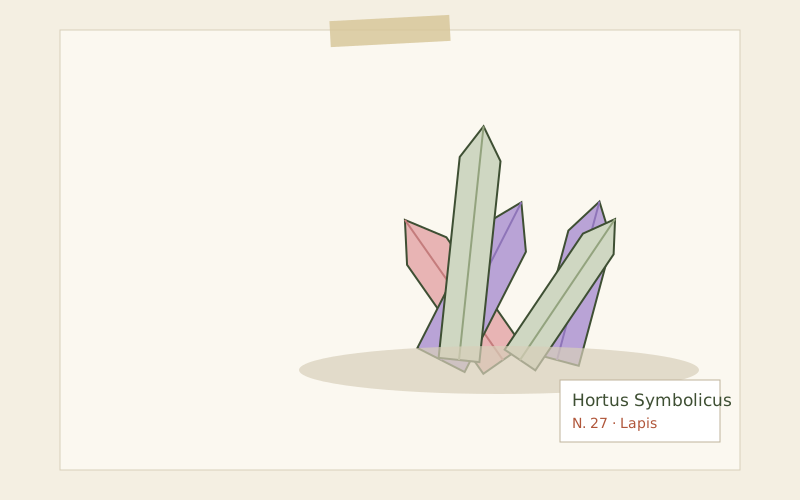
Amethyst is the violet variety of quartz, and its colour ranges from a pale lilac to a deep purple, sometimes with reddish glints like those of wine. It is precisely this link with wine that gave rise to its name and to much of its symbolism. Over the centuries amethyst has become the stone of measure, temperance and spiritual dignity, to the point of adorning the hands of bishops.
The name: "not drunken"
The Greek word amethystos is formed from the negative particle a- and the verb methyo, "to be drunk". It therefore means "not drunken". The ancients believed that the stone could keep its wearer from intoxication, and some authors mention the custom of carving cups from amethyst or dropping the stone into wine.
Already Pliny, however, considered this belief one of the many vanities of the magi. The meaning that remains valid is the symbolic one: amethyst has the colour of wine but does not intoxicate. It is wine turned into stone, ardour that becomes clarity.
A myth more recent than one might think
Many books relate that amethyst was born from an episode of Greek mythology: a maiden named Amethyst, pursued by Bacchus, was turned by Diana into a white crystal to save her; the god, repentant, poured his wine over the stone, colouring it violet.
This tale, often presented as an ancient myth, is in fact an invention of the French Renaissance. We owe it to the poet Remy Belleau, who included it in a collection of poems devoted to precious stones published in 1576. No Greek or Latin source records it. It is a good example of how symbolic tradition keeps growing: even a modern myth can express an ancient idea effectively, as long as its origin is known.
The meaning of the story is in any case consistent with the name of the stone: purity threatened by intoxication is preserved, and the god's wine settles on it without tainting it, becoming colour and beauty.
Violet and the liturgy
Violet holds a special place in Christian tradition. It is the colour of penance and waiting, used in the seasons of Advent and Lent. It is a threshold colour, halfway between the red of passion and the blue of contemplation. Amethyst, with its range of shades, is its natural expression.
In antiquity purple was reserved for kings and emperors, and violet long kept an aura of dignity and authority. In the Church bishops wear violet vestments, and amethyst became one of the stones most used for the episcopal ring. The union of a royal colour with the meaning of temperance made it the ideal stone for those who had to exercise spiritual authority: a sober power that does not let itself be intoxicated by itself.
Amethyst in Revelation
In the Book of Revelation amethyst is the twelfth of the foundation stones of the heavenly Jerusalem. Medieval authors who commented on this passage often associated it with humility and with thought turned towards the Kingdom, completing the series of virtues that the twelve stones were meant to represent.
Symbolic meanings
| Aspect | Symbolic meaning |
|---|---|
| name "not drunken" | sobriety, measure, lucidity |
| colour of wine | transformed ardour, purified passion |
| liturgical violet | penance, waiting, threshold |
| episcopal ring | spiritual authority, sober dignity |
Temperance as a virtue
Among the four cardinal virtues of the classical and Christian tradition, temperance is the one that governs desire. It is not renunciation but balance: the ability to enjoy things without being ruled by them. Amethyst is a perfect symbol of it precisely because it does not deny wine. It keeps its colour, its beauty, even its warmth, but transforms it into something stable and clear.
In the Temperance card of the tarot, an angel pours a liquid from one vessel to another without losing a drop. Although the card is not directly linked to amethyst, the symbol is the same: the harmonious passage between two states, the measure that makes transformation possible.
Contemplating amethyst
Anyone who looks at an amethyst crystal in the light will notice that the colour is not uniform: it gathers in some areas, fades in others, sometimes arranges itself in bands. It is an effective image of inner balance, which is not a fixed condition but a continual modulation. The stone reminds us that sobriety is not grey: it has a colour, and one of the most beautiful.
In short
- The Greek name amethystos means "not drunken": amethyst is the stone of sobriety.
- The myth of the nymph Amethyst and Bacchus is an invention of the Renaissance poet Remy Belleau.
- Violet links it to liturgical penance and to dignity, and made it the stone of episcopal rings.
- It symbolises temperance: an ardour that is not denied but transformed into clarity.